Yours
- licence
- Apache-2.0 or MIT
- runs on
- Metal on macOS (Apple silicon) · Vulkan on Linux and Windows (WSL2)
- in the box
- 70 ops · 20 MCP tools · the live player · the render service
- costs
- nothing, at any scale
Open source · Apache-2.0 or MIT
Videos are JSON your agent writes, checks and renders on the GPU.
{
  "format": { "width": 1080,
    "height": 1920, "fps": 30 },
  "nodes": {
    "vessel": {
      "op": "shader",
      "params": {
        "code": "// a lathe, its profile keyed…",
        "u4": { "keys": [ … ] } } },
    "title": {
      "op": "text",
      "params": {
        "text": "Spin something new.",
        "font": "ultrafast:display",
        "size": 176 } },
    …
  },
  "output": "grain"
}Use cases
What agents made with it, and each brief in a sentence.
Cut the Apollo 11 and Artemis I launches together on the 1969 countdown. Make it feel like a documentary.
Pull the best 25 seconds from this episode. Captions on, vertical, our colours.
A launch film for our 35 mm lens: the knurling, the iris, an exploded view, then the price.
Make every member their year in review from this spreadsheet.
Turn NOAA's Mauna Loa CO₂ file into a chart for Instagram.
A 15-second loop for the album cover: something growing, in celadon.
How it works
Each plate is a node in one JSON document. Point at a line to find its plate; click to pull it.
3D and 2D
One engine renders 3D models, type, vector shapes, charts and footage, and composites them in the same frame. No Blender, no After Effects, no plugins: all of it is in the document.
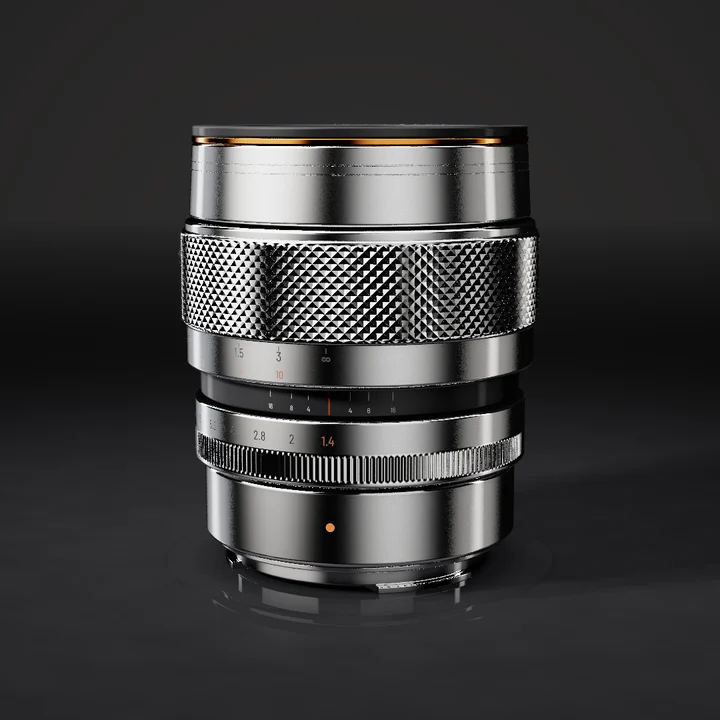
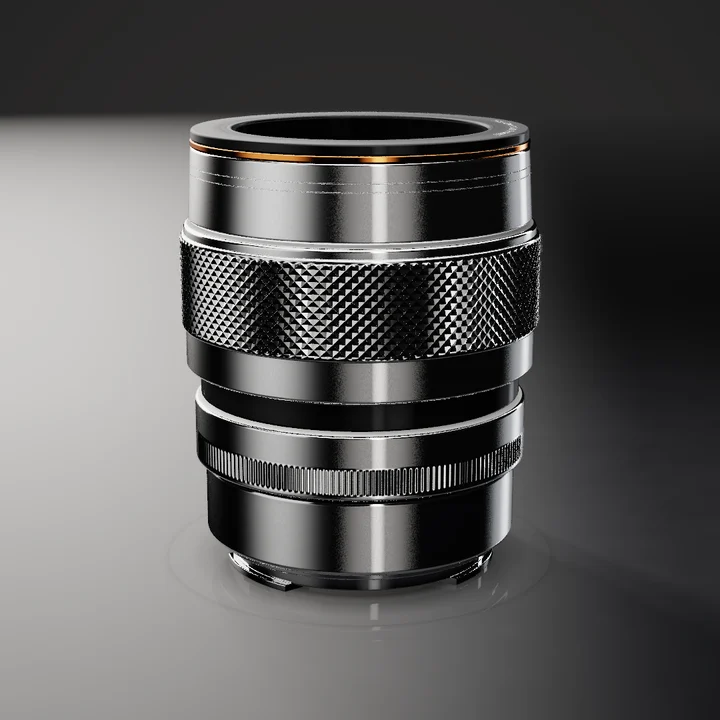


The lens and the pot are geometry and materials in their documents, lit and rendered by ultrafast, not made in a 3D app. Turning the camera is one more render of the same node: about 0.3 s.
Speed
1920×1080 · 6-sample motion blur · one RTX 5090
press log
no browser in the loop
Review
uf review read all 300 frames in 4.7 s.
 0 findings
newstarts from a templatecheckfinds problems without renderingreviewreads every frameexportthe teaser in 1.68 sEdits
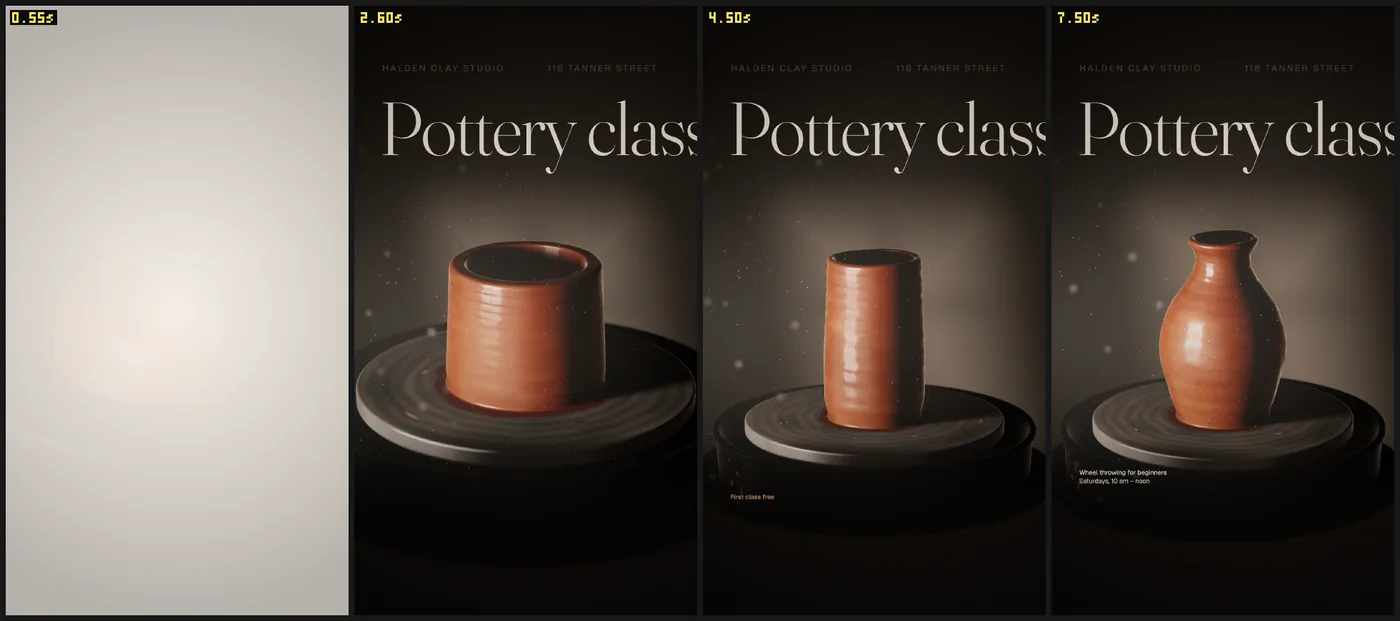
Your agent edits the document, not the pixels. One sentence changed one node: the pot's shape, its camera and its shader. The type, light and timing stayed as they were.
This works today in Claude Code, Codex, Cursor and Gemini CLI with uf mcp.
Coming soon The ChatGPT app and the Claude connector, for making videos in a chat. Join the waitlist
A 10-second vertical teaser for my pottery class. Saturdays, first class free.
Make it a wide bowl instead of a vase.
Compare
Remotion and HyperFrames draw each frame in headless Chrome and capture it. ultrafast draws it on the GPU, and your agent writes a fifth of the tokens.
| ultrafast | Remotion | HyperFrames | |
|---|---|---|---|
| Draws each frame with | GPU kernels, Metal or Vulkan | headless Chrome, a screenshot per frame | headless Chrome, captured frame by frame |
| You write | one JSON document | a React project | HTML, CSS and JavaScript |
| Output tokens for a 10 s short | about 1,100 | about 5,500 | about 4,400 |
| Published speed, 1080p | 300 frames in 0.34 s, with 6-sample motion blur, on one GPU | an 80 s video in 15 s, split across up to 200 Lambda functions | 300 frames in 9.8 s |
| Agents review their frames | check, review, inspect, frames and contact sheets | no built-in review | no built-in review |
| Licence | Apache-2.0 or MIT | free up to 3 people; companies pay per render or per seat | Apache-2.0 |
| Hosted rendering | ultrafast Cloud, coming soon (waitlist); uf serve on your GPU today | none: Lambda in your AWS account | HeyGen credits, or your own Lambda or Cloud Run |
Remotion and HyperFrames figures are from their own docs, November 2026. Sources.
Integrations
uf mcplocal · 20 toolsAvailablenpx skills addultrafastmov/ultrafastAvailableuf serve/mcp on your server, one keyAvailablepip install ultrafastmovnpm i ultrafastmovAvailabledocker run …the HTTP API on one GPUAvailableTwo ways to run it
Questions
An open-source video engine built for AI agents. A video is a JSON document of nodes (footage, type, shapes, 3D, effects); ultrafast checks it, shows the agent its frames and renders it on the GPU at hundreds of frames a second.
Yes, for now: a Mac with Apple silicon, or a computer with a Vulkan GPU on Linux or Windows (through WSL2). ultrafast Cloud, which renders on our GPUs, is coming soon: join the waitlist.
Yes. Cut, trim, speed-ramp, reframe, grade, key and caption video files, mix in music and voiceover, and add titles, logos and charts. The footage examples cut, caption and grade NASA film and sound.
Yes. The pot, the lens, the compass, the chrome ring, the Earth and the Moon are geometry and materials written in each film's document. ultrafast lights and renders them on the GPU every frame, in the same pass as the type. Nothing was filmed, and nothing was made in a 3D app.
Any size and frame rate: 9:16, 1:1, 4:5, 16:9, 21:9 or your own, up to 4K. Exports are MP4 or MOV in H.264 or HEVC, with sound.
They draw each frame in headless Chrome and screenshot it. ultrafast draws on the GPU with no browser: 300 frames of 1080p with motion blur in 0.34 s on one RTX 5090, where HyperFrames' own guide gives 9.8 s for 300 frames. It also gives agents tools to check and review their videos. See the comparison.
Yes, about a fifth as many. A 10-second short is about 1,100 output tokens of JSON. The same short is about 5,500 tokens as a Remotion project and 4,400 as a HyperFrames composition, and most of that is web code. See tokens.
Nothing. The engine is free under Apache-2.0 or MIT, for commercial use, at any scale.
Not yet. ultrafast Cloud will run the same engine on our GPUs with one API key, and the ChatGPT app and the Claude connector will run on it. Join the waitlist and we'll email you when it opens.
Want it hosted? Join the ultrafast Cloud waitlist.